• Pests in House and Home
  • Bedbugs – Bites, Stings and Itches
  • Food Pests
  • DPIL

Pestium.uk

Europe's largest scientific bug site

Danish flagUnion JackNorwedish flagSwedish flagGerman flag
You are here: Home / Food Pests / The various species / The flour mite

The flour mite

Flour mite, Acarus siro

Latin: Acarus siro (synonyms are Tyroglyphus farinae and Aleurobius farinae). Also called forage mite.

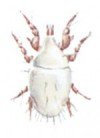
A white, oval mite with red or yellow legs. It can be up to 0.65 mm long. The main characteristic of the flour mite is that the male has a large, thorn-shaped outgrowth on the first pair of legs. The flour mite is the most common mite in humid grain and damp cereal products, especially flour and grain, where the water content is significantly above 13. The flour mite can be found in stocks of hay, straw, canola, seeds and feed. The flour mite can live and reproduce in environments where the relative humidity is between 62 and 99% and the temperature is between 4 and 32 ° C. It develops most rapidly at a relative humidity of 80-85% and 21-27 ° C. Research has shown that a population of flour mites in can become 2500 times more numerous compared to the original number in just a month. By comparison, the rust-red flour beetles, which hold the record among insects in rapid population development, only increase its numbers by 70 times a month. In grains and seeds for cultivation damages primarily depend on the fact that the flour mites eat seeds and without seeds there is no sprouting. From a consumer point of view, the main reasons to avoid many flour mites are the following:
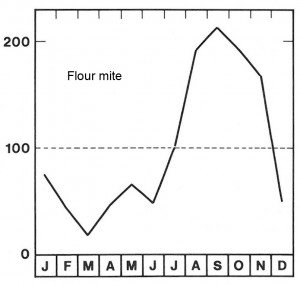
Season for flour mites

1. The mites are responsible for the amino acid nitrogen percentage being reduced. By feeding selectively they cause reduction in quality in products and feed.

2. Flour mites smell. Firstly, they have glands, which give a special stinging odour and on top of that the mites rot when they die.

3. There are many reports of animals which have become sick or even died from eating feed heavily infested with mites. Polish experiments with people, who ate food containing mites, show that diarrhea is a typical reaction to the presence of mites. However, there are some fundamental difficulties in placing the roles of mites in diseases connected with food or feed infested with mites. The mites live with high amounts of bacteria and fungi, and the importance of these should not be underestimated. The mites are only in the picture because they are what can be seen with the naked eye. In cases of pig deaths, where the mites have been suspected to be the cause, there have never been major amounts of mites present, but more often there have been moth larvae and moth web in the feed.
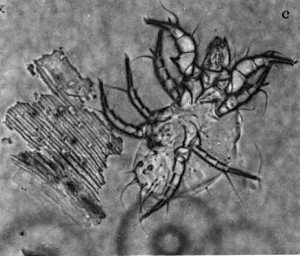
Flour mite
Flour mite

4. Frequent or massive inhalation of flour mites can cause reactions of hypersensitivity. Some scientists today believe that the former debilitating baker’s asthma was not actually due to the flour, but that flour mites may have caused it.

The flour mite is part of a complex of species. People who are allergic to flour mites are also likely to react to its close relative, Acarus farris, and perhaps the house dust mite too. Acarus farris live in damp hay and straw in concentrations that could exceed 1 million mites per kilo. It is so closely related to the flour mite that they can hybridize and they probably have the same allergens.

Flour mites are exterminated most easily by moisture removal – in grain and flour to less than 13% water – or by rejecting the goods. Flour mite eggs tolerate poison gas, so this method is not suitable for extermination of mites. Flour mites in visible or smellable amounts should hardly be tolerated in any food.

  • About
  • Latest Posts
Henri Mourier
Biologist at Statens Skadedyrslaboratorium
Author of:
"Pests in House and Home"
"Bed Bugs - Bites, Stings and Itches"
"Food Pests"
"Husets dyreliv" (Insects Around the House - Only danish)
"Skadedyr i træ" (Timber Pests - Only danish)
"Stuefluen" (Common Housefly - Only danish)
Latest posts by Henri Mourier (see all)
    Food Pests
    Introduction
    An old problem
    Competition for food
    Pests can ruin stored goods
    Why not just eat the insects
    Some insects are unhealthy to eat
    Allergy to pests
    Transmission of infectious diseases
    Where do pests come from?
    Synanthrope species
    (1) The house dust mite and the sugar mite
    (2) The firebrat and the silverfish
    (3) The German cockroach and the forest cockroach
    (4) The rust-red flour beetle and the confused flour beetle
    (5) The merchant grain beetle and the saw-toothed grain beetle
    (6) The cigarette beetle and the drugstore beetle
    (7) The rice weevil and the granary weevil
    (8) The pharaoh ant and the common black ant
    History of the dark flour beetle
    Pests in bird’s nests
    Mould fauna
    The Look and Behaviour of pests
    Insect appearance
    Internal
    Insect development
    Insect senses
    Behaviour
    Water and Moisture
    Temperature
    What insects live off and live in
    The Air
    Mites
    Bug Indentification
    The various species
    Mites
    The flour mite
    The sugar mite
    The common house mite
    The Lardoglyphus zacheri
    The prune mite
    The cheese mite
    The house dust mite
    The Cheyletus eruditus
    Silverfish
    The Silverfish
    The firebrat
    Cockroaches
    The German cockroach
    The Oriental cockroach
    The brown-banded cockroach
    The American cockroach
    The extermination of cockroaches
    Crickets
    Earwigs
    Booklice
    Butterflies
    The Mediterranean flour moth
    The warehouse moth
    Tropical warehouse moth
    The brown house moth
    The Indian meal moth
    Grain beetles
    The saw-toothed grain beetle
    The merchant grain beetle
    The rust-red grain beetle
    Flour beetles
    The yellow mealworm beetle
    The lesser mealworm beetle
    The dark flour beetle
    The confused flour beetle
    The rust-red flour beetle
    The bolting cloth beetle
    Furniture beetles
    The drugstore beetle
    The cigarette beetle
    Bostrychidae
    The lesser grain borer
    True weevils snout beetles
    The granary weevil
    The rice weevil
    The corn weevil
    Bean weevils
    The common bean weevil
    The coffee bean weevil
    Skin beetles
    The bacon beetle
    The dermestid beetle
    The leather beetle
    The khapra beetle
    The reesa vespulae
    Chequered beetles
    The red-legged ham beetle
    The red-breasted copra beetle
    The black-legged ham beetle
    Spider beetles
    The Australian spider beetle
    The white-marked spider beetle
    The golden spider beetle
    The smooth spider beetle
    Plaster beetles
    Flies
    The common house fly
    The lesser house fly
    Blowflies
    The grey flesh fly
    The cheese skipper
    Fruit flies
    Hymenoptera
    The common black ant
    The pharaoh ant
    Wasps
    Birds
    The domestic pigeon
    The house sparrow
    Prevention and control of birds
    Rodents
    The house mouse
    The yellow-necked mouse
    Mouse prevention
    Mouse control
    The brown rat
    The black rat
    Rat prevention
    Rat control
    Imaginary pests
    Niches of food pests
    A: The Waste Niche
    B: The seed niche
    C: The dead plant niche
    D: The sugary excrement niche
    E: The carrion niche
    Prevention and Control, Integrated Control
    A. Inspection of the company and its environment
    The environment
    The premises
    Examination of raw materials and food on site
    Sampling
    Laboratory methods for detection of pests in food
    B. Statement of the problem
    C. Prevention and control
    1. Proper organisation of the company
    2. Proper operation
    3. Exclusion, proofing buildings
    4. Packaging
    5. Non-chemical control measures
    6. Chemical control
    D: Effective monitoring and communication
    Practical information
    Index

    Copyright © 2026 · The publisher Pestium Inc. · Europe's largest knowledge database on pests.
    Copying and reproduction without permission is prosecuted without prior notice